
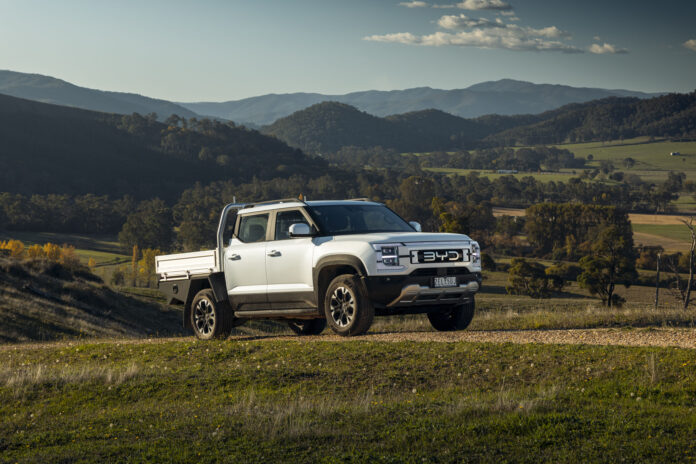
BYD has expanded the Shark 6 lineup to three variants, and the newcomer aimed squarely at tradies and fleet buyers is the Shark 6 Dynamic Cab-Chassis. Priced from $55,900 plus on-road costs
The new BYD Shark 6 Dynamic Cab Chassis sits $2,000 below the Shark 6 Premium and trades some of the creature comforts of that higher-spec model for genuine worksite practicality. The question is whether stripping things back makes it a better ute for the people it is designed for, or whether the compromises are too much. Having driven it both unladen and with 400 kg in the tray, I can tell you it is a genuinely impressive piece of kit.
Quick Specs
| Specification | Detail |
|---|---|
| Price (before on-roads) | $55,900 (cab-chassis) |
| Ironman 4×4 Alloy Tray | $5,000 + $1,155 fitment |
| Drivetrain | Dual Mode Off-Road (DMO) Super Hybrid AWD |
| Engine | 1.5L turbo petrol |
| System Power | 321 kW |
| System Torque | 650 Nm |
| 0-100 km/h | 5.7 seconds |
| Battery | 29.6 kWh BYD LFP Blade Battery |
| EV Range (WLTP est.) | ~80 km |
| Combined Range (WLTP est.) | ~700 km |
| DC Fast Charging | Up to 55 kW |
| AC Charging | Up to 7 kW |
| Braked Towing | 2,500 kg |
| GVM | 3,500 kg |
| GCM | 5,750 kg |
| Kerb Weight (without tray) | 2,600 kg |
| V2L Output | 6.6 kW |
| ANCAP Rating | 5 Stars |

The Tray: Ironman 4×4 Built, BYD Blessed
The most obvious change from the Shark 6 Premium is what is out back, or rather, what is not. Instead of the moulded tub, you get an open cab-chassis platform ready to accept a body or tray. BYD has partnered with Australian aftermarket specialist Ironman 4×4 to develop a heavy-duty alloy tray that can be ordered and fitted through BYD dealerships. It is an optional extra, priced at $5,000 plus $1,155 for fitment, so factor that into your budget if you are comparing it against the Premium.
The tray itself is a quality piece. It measures 1,679 mm x 1,809 mm x 259 mm and features eight integrated tie-down points that are spring-loaded and retract flush when not in use, which means you can slide a pallet or flat load straight in without anything catching. The tailgate is solid, with proper latches on either side and rubber stops to protect the body. I drove this thing on-road and off-road, over rocks and roots, and did not hear a single rattle from the tray. That tells you everything about the build quality.
There are two lockable toolboxes, one on each side of the tray. The right-hand box is where BYD has relocated the charging port and 10-amp sockets, pulled from inside the tub that no longer exists on this variant. It is a smart solution and the boxes give you a bit of extra secure storage as a bonus. The fuel filler port has moved to the front of the tray on the left side. The tray is ADR 92/00 compliant, keeps all ADAS systems intact, and is covered by BYD’s six-year vehicle warranty. An optional trundle tray is also available if you need that extra pull-out work surface.
One small observation: the tray has rubber stops on the tailgate but not on the side panels. If you are unlatching a side panel, it will contact the body. A strip of mastic tape along that fender edge will sort it out, but it is worth knowing before your first day on the tools.

The Cabin: Familiar, But Trimmed Down
Step inside and the Dynamic cabin is immediately familiar to anyone who has spent time in the Shark 6 Premium. The layout is the same, the fighter jet-style button cluster in the centre console is all there, and you still get a single wireless phone charger, two cup holders, and a solid centre console storage area. The rear seat is genuinely spacious, with acres of knee room, adjustable rear vents, a small cubby, USB ports, and a 10-amp socket back there too, which is handy if you want to run a fridge off the back seat.
Where things differ is in the details. The steering wheel is wrapped in synthetic leather rather than genuine leather. The infotainment screen is a 12.8-inch unit rather than the rotating 15.6-inch screen on the Premium. It does not rotate, but it still supports wireless Apple CarPlay and Android Auto and retains most of the same functionality. The heads-up display is not available on this variant, footwell lighting is gone, and heated and ventilated seats are not on the options list either. For tradies and fleet buyers, none of that is likely to keep them up at night.
The Powertrain: Same Punch, Same Efficiency
Under the bonnet, the Shark 6 Dynamic runs the same drivetrain as the Premium. That is a 1.5-litre turbocharged petrol engine producing 135 kW and 260 Nm, paired with dual permanent magnet synchronous electric motors to give a combined system output of 321 kW and 650 Nm. It will get you from zero to 100 km/h in 5.7 seconds, which is quick for anything, let alone a working ute.
BYD’s DM Super Hybrid system gives you three driving modes. In EV Pure mode, the petrol engine switches off completely and the electric motors do all the work from the 29.6 kWh LFP Blade Battery. In HEV Series mode, the petrol engine acts as a generator, sending power to the electric motors without directly driving the wheels. In HEV Parallel mode, the engine and motors work together for maximum output, which is where you want to be when towing or cruising at highway speeds. The transitions between modes are seamless. You do not feel them happening.
Real-world EV range is around 80 km on WLTP once you convert from the NEDC figures BYD quotes officially, and combined range is in the 700 km ballpark. DC fast charging tops out at 55 kW and AC at 7 kW.
Loaded vs Unladen: A Tale of Two Utes
I drove the Dynamic in two configurations: unladen, and with 400 kg of weight in the tray. The difference was immediately noticeable, and in a good way. Unladen, it handles well for a ute of this size, but you can feel a slight front-heavy bias from the engine sitting up front. Put 400 kg in the tray and that imbalance disappears completely. The Blade Battery sits right in the middle of the chassis as a structural element under the floor, which gives the car naturally good weight distribution, and the load in the tray just brings everything into balance.
Under hard braking from 80 km/h with 400 kg on board, the Dynamic pulled up cleanly. Under hard acceleration, it wheelspin briefly before hooking up and pulling hard. That is the fundamental advantage of electric motors driving the wheels rather than a petrol engine. You just send more current to the electromagnets and the torque is there instantly. There is none of the strain you feel in a conventional ute when you load it up. The Dynamic simply does the work.
BYD also claims the cab-chassis body is actually more torsionally rigid than the Premium’s tub body, thanks to the way the Ironman tray integrates with the chassis structure. On rough surfaces, I would not argue with that claim.

Off-Road and Towing Capability
The Shark 6 Dynamic rides on double-wishbone independent suspension front and rear, a genuine advantage over traditional leaf spring setups that prioritises ride comfort and handling without giving up load capacity. Terrain modes cover Mud, Sand, Snow, and Mountain. Crawl Mode, which debuted on the Performance variant, will be rolled out to Dynamic owners via an over-the-air update later in the year, capping speed at 12 km/h and continuously adjusting torque to keep the wheels moving on tough terrain.
Braked towing is rated at 2,500 kg, with a GVM of 3,500 kg and GCM of 5,750 kg. The front axle is rated to 1,651 kg and the rear to 1,927 kg, with a tow ball download limit of 250 kg. Without a tray, the Dynamic weighs 2,600 kg, around 110 kg less than the Premium with its tub. That means if you spec a tray that weighs under 110 kg, you actually end up with more payload available in the Dynamic than in the Premium. Worth running the numbers before you order.
V2L and Worksite Ready
The Shark 6 Dynamic comes with 6.6 kW of Vehicle-to-Load capability and a 230-volt socket in the cabin. In the Premium that socket would be in the tub, but here it is relocated appropriately. With a V2L adaptor you get two more outlets, giving you real power capacity for tools and equipment on site. For tradies, this is a genuine selling point: your ute becomes a mobile power source for the job.

Safety
The full ADAS suite carries over from the Premium, covering automatic emergency braking, lane departure warning, lane keeping assist, adaptive cruise control, blind spot detection, rear cross traffic alert, driver fatigue monitoring, and more. The 360-degree camera is standard. All Shark 6 variants hold a five-star ANCAP rating.
The Verdict
The Shark 6 Dynamic Cab-Chassis is exactly what BYD says it is: a workhorse for the workforce. It strips out the luxury items that a tradie or fleet operator does not need and delivers the same powertrain, the same capability, and arguably more payload potential, in a more practical package. The Ironman 4×4 tray is a well-engineered, rattle-free addition that integrates cleanly with the vehicle. The cab-chassis starts at $55,900 before on-roads, and you can add the Ironman tray for $5,000 plus $1,155 fitment, bringing your all-up spend to around $62,055 before on-roads with the tray fitted.
For fleet buyers who want simple, essential, and capable, or for tradies who want a super hybrid ute that doubles as a worksite power station, the Dynamic Cab-Chassis deserves a serious look.
What do you reckon? Is the Shark 6 Dynamic going to make a dent in the tradie ute market? Drop your thoughts in the comments below, and if you found this useful, give it a like and subscribe to Beyond EV for more new energy vehicle content.

