

BYD’s first people mover isn’t dressed up as a luxury flagship. It’s built to sit in Kia Carnival driveways.
BYD Australia has confirmed its first people mover. The M9 lands in local showrooms during the final quarter of 2026 badged as BYD, rather than folded into the premium Denza range, and aimed squarely at the Kia Carnival. BYD’s own Denza D9 already covers the prestige end of the segment. The M9 doesn’t: it’s priced, sized and specified to fight where the actual volume sits.
The Basics
The range opens with a seven-seat Premium variant, powered by BYD’s DM-i 5.0 Super Hybrid system: a 1.5-litre turbo-petrol engine paired with an electric motor driving the front wheels only. An eight-seat Dynamic follows later, adding a seat but running a smaller battery.
Premium uses a 36.60kWh Blade Battery, good for up to 145km of WLTP electric range and 850km combined. Dynamic gets a 20.39kWh pack but BYD hasn’t released its range figures yet. Both variants support AC and DC charging plus Vehicle-to-Load, so the M9 can run camp fridges, power tools or a barbecue straight off its own battery.
| Variant | Seats | Battery | EV Range (WLTP) | Combined Range (WLTP) | Drive | Price |
|---|---|---|---|---|---|---|
| M9 Premium | 7 | 36.60kWh Blade Battery | Up to 145km | Up to 850km | FWD | TBA |
| M9 Dynamic | 8 | 20.39kWh Blade Battery | TBA | TBA | FWD | TBA |
Fifth-Generation Super Hybrid
DM-i 5.0 is BYD’s newest hybrid architecture in global rollout since 2024. BYD’s claims for the platform are aggressive: 46% thermal efficiency from the petrol engine which puts it among the highest of any production unit, and fuel use as low as 2.9 litres per 100km once the battery’s charged. The gains come from three areas: the engine and gearset itself, thermal management across the cabin and battery, and a more integrated electrical architecture.
Australian government approval paperwork lodged ahead of this week’s announcement lists two power figures for the M9: 191kW and 218kW, most likely split between Dynamic and Premium. Outputs elsewhere have varied: the M9 badge in other export markets carries a combined rating of 200kW and 315Nm.
The same 5.0 hardware is already spreading through BYD’s range, from the Sealion 8 to the Seal 06 Station Wagon. But the M9 is its biggest application yet.
Dynasty Roots
The M9 isn’t a new design pulled together for export. It’s BYD’s flagship Dynasty-series MPV first revealed in China in 2024 and on sale there since January 2025 as the Xia, named for the country’s first ruling dynasty. Beyond EV covered that original reveal as it happened (video below), two years before BYD ever confirmed a badge for Australia. Dimensions carry straight across: 5,145mm long, 1,970mm wide, 1,805mm tall, on a 3,045mm wheelbase, identical to the Chinese-market car.
BYD’s styling pitch leans on a traditional Chinese garden as inspiration, all strong horizontal and vertical lines with a dragon-motif nose. It’s a formal, MPV-first look rather than the SUV-flavoured styling Kia uses on the Carnival.
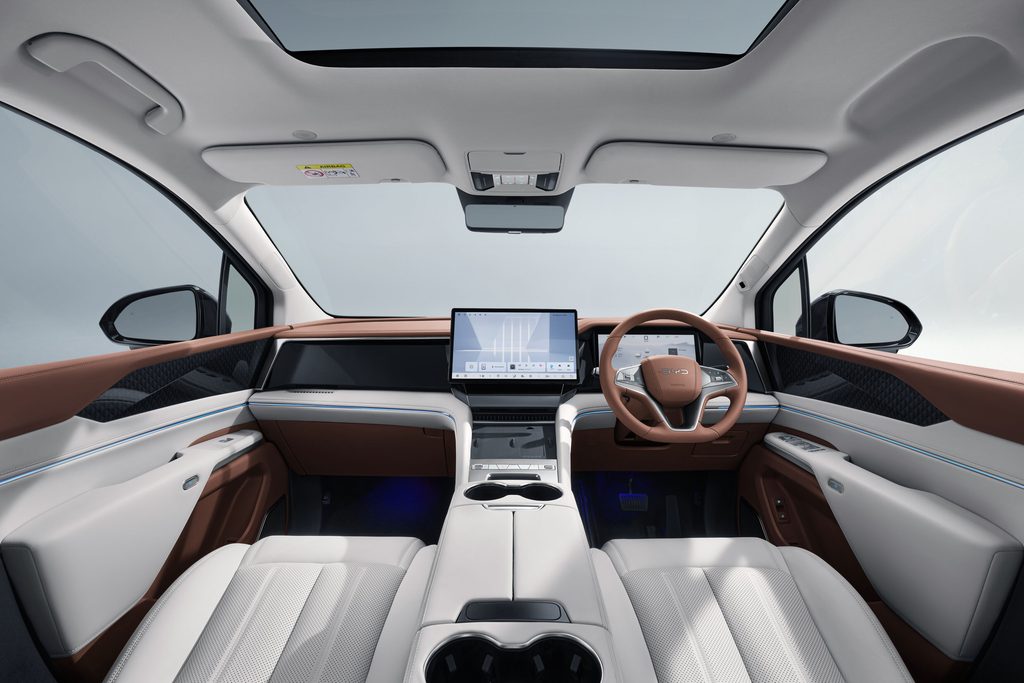
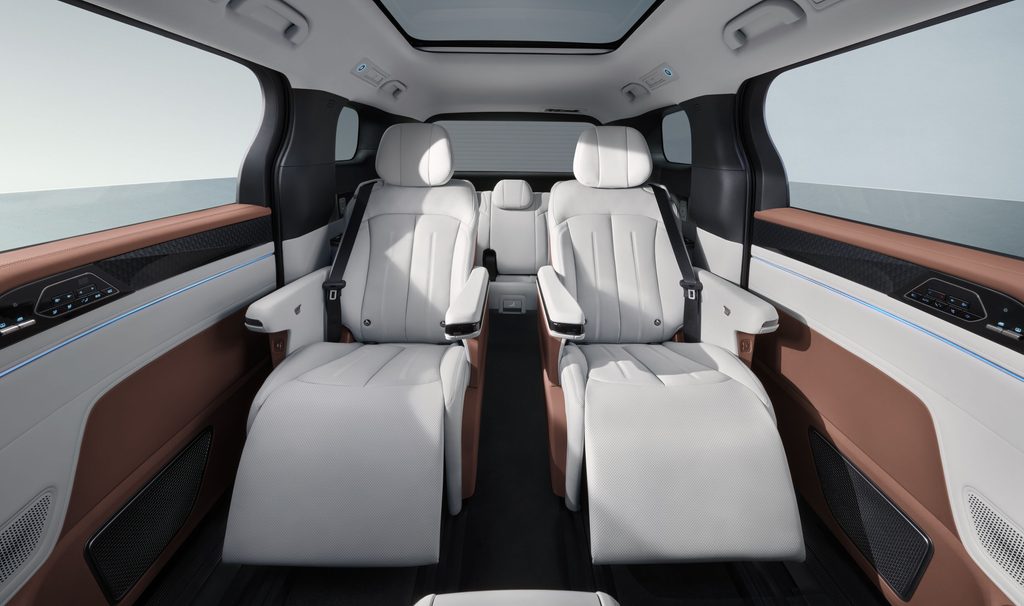
Inside, Premium models add heated and ventilated front seats. Second-row captain’s chairs bring heating, ventilation and a near-zero-gravity seating position, the kind of feature usually reserved for cars wearing a much higher price tag.
Space, Towing and Safety
Boot space is rated at 470 litres with all three rows in place, around 25% down on the Carnival’s 627 litres. Braked towing capacity is 1,500kg: enough for a small trailer or a couple of jet skis.
Safety runs deep on paper. High-strength steel makes up 73% of the body structure and the specification sheet includes up to nine airbags, a 360-degree camera system, five millimetre-wave radars and eight ultrasonic sensors, feeding a full driver-assist suite. ANCAP testing hasn’t been confirmed but the sensor count already puts the M9 ahead of most mainstream people movers on paper.
The Carnival Problem
Kia has owned the Australian people mover segment for more than 15 years. This year it’s taken roughly three in four sales in the category, with nothing else getting close: not the Hyundai Staria, not the Ford Tourneo, not any of the recent Chinese arrivals.
That’s mostly because those arrivals haven’t really tried. BYD’s own Denza D9 launched locally earlier this year at $85,990 to $95,990 plus on-road costs, chasing V-Class buyers rather than Carnival ones. The GAC M8 got there first as the segment’s original plug-in hybrid, but it’s a niche player rather than a genuine Carnival rival.
The M9 is different. It’s priced to core-BYD money rather than premium-Denza money, sized to match the Carnival almost panel for panel, and backed by a plug-in hybrid powertrain that adds real EV-only running the Carnival’s conventional hybrid simply doesn’t have.
The BYD M9 will be well suited for Australians needing space and practicality while also expecting efficient performance with BYD’s advanced DM Super Hybrid powertrain technology.
Stephen Collins, BYD Australia Chief Operating Officer
Pricing and Timing
BYD hasn’t released Australian pricing or a firm on-sale date beyond “Q4 2026” with more detail promised closer to launch.
In China, the equivalent Xia spans four trims from roughly 207,000 to 270,000 yuan, or somewhere near $43,000 to $57,000 AUD at current exchange rates, before duties, GST, compliance costs and dealer margin get added. Australian pricing will land higher than that raw conversion suggests, but the gap up to Denza D9 money gives BYD plenty of room to sit well under the Carnival’s top-spec pricing and still turn a profit.
Kia has had this segment to itself for a long time and the M9 appears to be the first Chinese challenger actually built to possibly end that run, not just to have a go at it.

